We had been talking about the sense of modesty that can come with undressing — removing the layers. This is what the exhibition by Theresa Kraft (Tübingen, 1983) at the Espacio Refugio of Shiras Gallery is about.
Read more about Between the Layers, January 2026 at Shiras Gallery, Valencia:
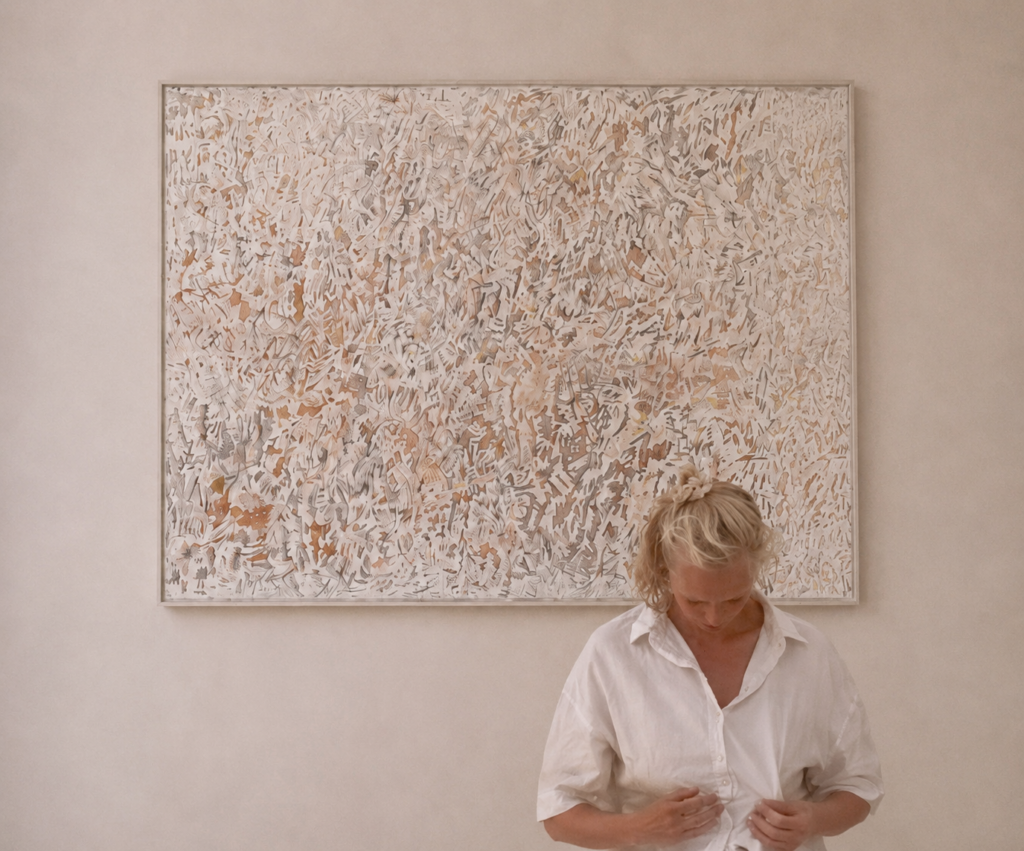
Between the Layers speaks of what we cannot say; of all the layers that must be removed to reach our true selves. “When we meet, we intend to see what lies between the layers,” because only then can we truly see the person standing before us.
Kraft’s work is made using natural pigments created by the German artist herself. Superimposed dyes, graphic lines, scraping, and transparencies generate surfaces in which each layer preserves the memory of the previous one. The warm colors that make up the work do not make noise: “They have to remain silent so that you can delve into your feelings,” to see how many layers separate the surface from your true self. The raw tones and the silence that emanates from them invite reflection: “I have a question for anyone who looks at my work: what lies beneath your layers?” Kraft asks.
Between the Layers is part of a collection of three exhibitions: In the Layers, Between the Layers, and Under the Layers. In this case, the “between” in the title does not refer to emptiness, but rather to a meeting place with what remains unspoken — with that inner knowledge that barely touches consciousness. Nothing ever disappears completely; what is hidden remains latent, ready to emerge under certain conditions of light or perception.
The gallery director, Sara Joudi, has emphasized the connection shared by both artists: “From distinct languages and methodologies, their practices investigate the concept of the invisible within human experience, addressing what operates at the margins of perception, memory, and sensitivity. Vulnerability is articulated here not as fragility, but as a point of persistence, resistance, and transformation.”
With this exhibition, Shiras Gallery has opened the year with a program committed to reflecting on the invisible: what is repaired and what settles, what is shown and what is merely suggested.